
DTF vs. Sublimation Printer: Which Should You Choose?
DTF Printer vs Sublimation Printer: Which One Is Right for You?
If you’re trying to decide between a DTF printer (or Powderless DTF+) vs. sublimation printer, you’re not alone—this is one of the most common questions for anyone starting a T-shirt or custom printing business.
Here’s the honest, straightforward answer:
-
DTF printing gives you more flexibility—you can print on cotton, dark shirts, and almost anything.
-
Sublimation printing is simpler and cheaper to start, but it only works on polyester and polymer coated products.
So the real question isn’t which is better overall…
it’s which one fits your business right now.
Let’s break it down in a way that actually makes sense.
What Is DTF Printing?
DTF stands for Direct-to-Film.
Instead of printing directly onto a shirt, you:
-
Print your design onto a special film
-
Add adhesive powder (or use a sheeted adhesive sheet with Powderless DTF+)
-
Heat press it onto the fabric
That’s it.
Why people love DTF:
-
You can print on cotton, polyester, blends, hard substrates —pretty much anything
-
It works great on dark shirts
-
You get sharp, colorful designs
If you’re planning to sell custom T-shirts seriously, DTF gives you a lot of freedom.
What Is Sublimation Printing?
Sublimation works differently.
Instead of sitting on top of the fabric, the ink actually becomes part of the material using heat.
What that means for you:
-
The print never cracks or peels
-
It feels like there’s nothing on the shirt
-
Colors look bright and clean
But here’s the limitation:
-
It only works on polyester
-
And usually on white or light-colored items, or polymer coated blanks
That’s why sublimation is popular for things like sports jerseys, mugs, and gifts.
DTF Printing vs. Sublimation: The Real Difference
If you just want the quick comparison, here it is:
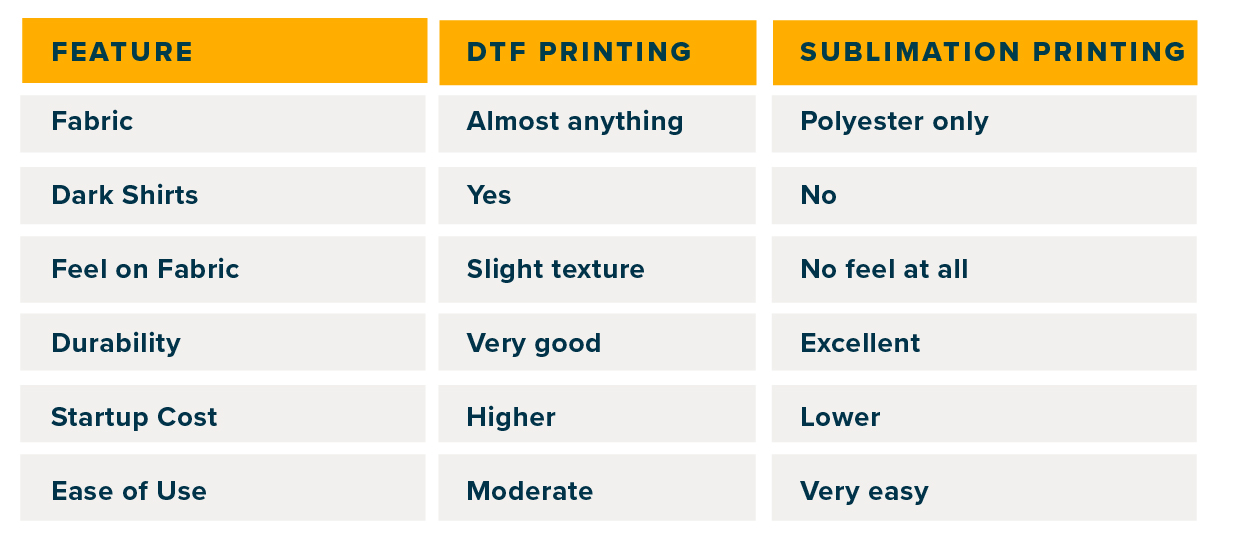
Big takeaway:
DTF = flexibility
Sublimation = simplicity
Let’s Talk About Ink
DTF Ink:
-
Includes white ink (or toner) (this is huge)
-
Sits on top of the fabric
-
Works on dark colors
Sublimation Ink:
-
No white ink
-
Soaks into the fabric
-
Needs light-colored materials
This is exactly why sublimation won’t work on black shirts.
DTF Transfer vs. Sublimation Transfer
This is where a lot of beginners get confused.
DTF Transfers:
-
You can print them in bulk
-
Store them
-
Even sell them separately
Great if you want to scale or sell online
Sublimation Transfers:
-
Printed and used immediately, or within a short timeframe
-
No storage
-
Limited to specific materials
Better for small, on-demand work
Startup Cost (What You’ll Actually Spend in the USA)
Let’s keep it real—budget matters.
Sublimation Setup:
-
Printer + heat press + supplies
Around $400 to $2,000 small format
DTF Setup:
-
Printer + film + powder system
Around $2,000 to $7,000 mid range equipment
So yes, DTF costs more upfront—but it also opens more doors.
So… Which One Should You Choose?
Here’s the simplest way to decide:
Go with DTF if:
-
You want to sell T-shirts (especially cotton)
-
You’re thinking long-term business
-
You want more product options
Go with Sublimation if:
-
You’re just getting started
-
You want to keep costs low
-
You’re focusing on mugs, gifts, or sportswear
What Most Successful Businesses Actually Do
Here’s something people don’t say enough:
A lot of U.S. businesses don’t choose just one.
They:
-
Start with sublimation (low risk)
-
Then move into DTF as they grow
That’s often the smartest path.
Pros and Cons (Quick Reality Check)
DTF Printing
Pros:
-
Works on almost anything
-
Great for scaling
-
High demand in apparel
Cons:
-
More expensive
-
Requires maintenance
Sublimation Printing
Pros:
-
Easy to learn
-
Affordable
-
Super durable prints
Cons:
-
Limited materials
-
Not ideal for apparel brands
Quick Summary (If You Skipped Everything)
-
DTF/ Crio Powderless DTF+ = more flexibility, higher cost
-
Sublimation = easier, cheaper, but limited
-
DTF is better for serious apparel businesses
-
Sublimation is perfect for beginners and side hustles
FAQs (Straight Answers)
1. What’s the biggest difference between DTF and sublimation?
DTF works on almost any fabric, while sublimation only works on polyester and light colors.
2. Which is better for a T-shirt business?
DTF is better if you want to sell a wide range of T-shirts, especially cotton.
3. Is sublimation cheaper than DTF?
Yes, sublimation is much cheaper to start with.
4. Can sublimation print on black shirts?
No, it won’t show up. You need light-colored materials.
5. Is DTF worth the investment?
Yes—if you plan to grow and sell more products long-term.
6. Can I start from home?
Absolutely. Both methods are commonly run from home setups in the U.S.
Final Thoughts
If you’re overthinking this decision, here’s the truth:
You don’t need the “perfect” choice—you need the right starting point.
-
Start simple → go with sublimation
-
Want more control and growth → go with DTF
Either way, real success comes from:
your designs, your branding, and your marketing—not just the printer.



0 Comments
Leave a Comment